
 Tiếng Việt
VISION
To become a leading, independent, pioneering, and trustworthy non-governmental science, technology, and innovation organization in Southeast Asia, playing a connecting role between knowledge, technology, and policy to promote smart, adaptive, and sustainable water resource management.
MISSION
To generate the impetus for knowledge, technology, and innovative solutions to support the State, localities, and communities in improving the efficiency of water resource management, strengthening resilience to climate change, and promoting sustainable development.
POSITIONING MESSAGE
The Institute is an independent, flexible, and innovative scientific institution that impacts the structural shift from “water resource management” to “smart water system governance” in the context of climate change and international integration.
STRATEGIC VALUE STATEMENT
The Institute exists to bridge the gap between science and policy, between data and decision-making, between ideas and action.
We do not just research water – we create ways for Vietnam to understand, manage, and protect its water resources in the future, aiming towards strategic socio-economic development goals, with culture at the center and science and technology as the driving force.
FUNCTIONS AND TASKS
The Southeast Asian Institute for Water Resources and Environment (SAIWRE) is a non-public science and technology (S&T) organization under the Vietnam Union of Science and Technology Associations (VUSTA), established in 2007. The Institute was granted a certificate of registration for science and technology activities No. A-634 by the Ministry of Science and Technology on September 20, 2024.
Functions:
To bring together dedicated and experienced scientists and professionals to conduct research and apply science and technology; to provide consulting, technology transfer, and science and technology services in the fields of agriculture, irrigation, hydropower, water resources, pollution control, and sustainable ecological development; to implement support and training activities to enhance capacity and develop communities, contributing to the socio-economic development of the country.
Tasks:
– Research on mechanisms and policies for smart water resource management that adapt to climate change and protect the environment.
– Research and experimental development (R&D) of programs, projects, and topics on efficient water resource management and exploitation, multi-purpose exploitation of irrigation works; improving institutional and policy frameworks for water resource governance, effective water management models linked to ecological agriculture, and developing reservoir operation procedures for multi-functional purposes.
– Research and application of technology in the construction of irrigation and hydropower systems, river regulation, water treatment, environmental protection, and water resource management for agriculture and rural areas; forecasting water resources, drought, saltwater intrusion, disaster prevention and mitigation, and adaptation to climate change.
– Training human resources and transferring technology, scientific and technical advancements in the fields of irrigation, hydropower, water resource utilization, environmental treatment, and rural infrastructure construction.
– Providing consultancy, appraisal, and evaluation of irrigation and hydropower projects, water resource utilization and exploitation; assessing environmental impacts; producing and commercializing research results for practical use.
– Collaborating and cooperating with domestic and foreign organizations and individuals to carry out the Institute’s tasks within the framework of the law and the regulations of the Vietnam Union of Science and Technology Associations.
STRATEGIC DEVELOPMENT TASKS (FOR THE NEXT 10-YEAR PERIOD 2025–2035)
- Research the scientific and practical basis to support the development and improvement of institutions and policies to enhance the effectiveness and efficiency of state management, risk management, and water security governance in the context of changing trends and rapid economic development;
- Research mechanisms and policies for smart water management adapting to climate change and environmental protection.
- Research science and technology solutions to serve the construction of new rural areas.
- Research solutions to urgent issues in the practical management of water resources, irrigation, and the environment regarding water security adapting to climate change, ecological conservation; sustainable water resource management; water culture, and ecological agricultural models linked to livelihood development for the community.
- Apply green and modern technologies in the construction, management, and exploitation of water resources, water forecasting, smart irrigation management, and water conservation.
- Closely coordinate with senior experts in developing comprehensive interdisciplinary and interregional strategies and solutions to address shortcomings in the practical management of water resources.
- Link with businesses to transfer technology and scientific and technical advancements in water supply, irrigation, environmental sanitation, and rural infrastructure development.
- Cooperate with international organizations and regional water associations in Southeast Asia in scientific research, consulting, and technology transfer in the field of water resources and environment.
ORGANIZATIONAL STRUCTURE
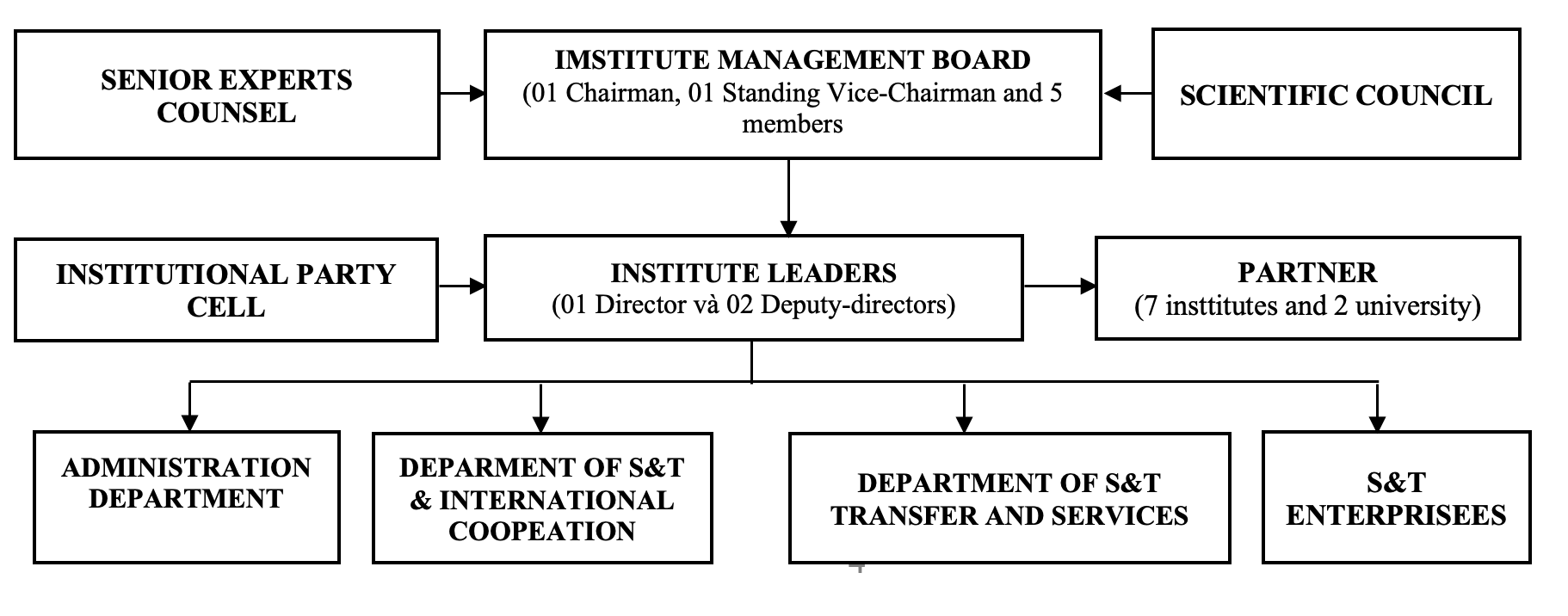
Organizational chart of the Southeast Asian Institute for Water Resources and Environment
List of members of the Institute’s Senior Advisory Council:
- Prof. Dr. Mai Trong Nhuan, former Director of Vietnam National University, Hanoi; Member of the National Advisory Council on Science and Technology Development, Innovation and Digital Transformation; President of the Vietnam Geochemistry Association; Senior Expert in Environmental Geology (Chairman of the Council);
- Prof. Dr. Tran Dinh Hoa, Director of the Vietnam Institute of Water Resources Science, Senior Expert in Hydraulic Engineering, Disaster Prevention and Water Resources;
- Prof. Dr. Tran Thuc, former Director of the Institute of Meteorology, Hydrology and Climate Change; President of the Vietnam Meteorology and Hydrology Association; Senior Expert in Meteorology, Hydrology and Climate Change;
- Prof. Dr. Truong Dinh Du, former Deputy Director of the Vietnam Institute of Water Resources Science, Senior Expert in Hydraulic Engineering;
- Prof. Dr. Le Sam, former Director of the Southern Institute of Water Resources Research, Senior Expert in Water Resource Engineering;
- Assoc. Prof. Dr. Dao The Anh, former Deputy Director of the Vietnam Academy of Agricultural Sciences; President of the Vietnam Rural Development Science Association (PHANO); Academician of the French Academy of Agriculture; Senior Expert in Agricultural Farming Systems;
- Assoc. Prof. Dr. Bui Quang Dung, former Director of the Institute of Sociology under the Vietnam Academy of Social Sciences, Expert in Sociology and Rural Development;
- Prof. Dr. Trinh Minh Thu, former Rector of the University of Water Resources, Expert in Irrigation, Hydrology and Geotechnical Engineering;
- Prof. Dr. Nguyen Vu Viet, former Director of the Vietnam Institute of Water Resources Science, Senior Expert in Hydropower and Renewable Energy;
- Assoc. Prof. Dr. Ha Luong Thuan, former Director of the Institute of Water, Irrigation and Environment, Senior Expert in Water Resources and Environment;
- Dr. Bach Quoc Khang, former Director General of the Department of Agricultural Product Processing and Salt Production, Chief of Staff of the Ministry of Agriculture and Rural Development, Senior Expert in Agricultural Industrialization and Rural Development.
- Dr. Lee Jeong Hyop, Senior Advisor to the governments of Thailand, Indonesia, and Laos in the fields of socio-economic development and science and technology; Senior Regional Expert on Sustainable Development in Southeast Asia; Advisor and consultant on socio-economic development policy for several countries in the Mekong sub-region, particularly concerning science, technology and innovation policies and strategies.
- Prof. Kuo Sheng Feng, Senior Advisor in the field of smart water management from Taiwan.
List of Specialized Experts:
– Assoc. Prof. Dr. Nguyen Van Tuan. Institute of Water Resources Planning. Expert in water resource planning.
– Assoc. Prof. Dr. Le Quynh Chi. Head of Planning Department, University of Civil Engineering. Member of the Executive Board of the Vietnam Urban Planning and Development Association. Architect, expert in planning.
– Assoc. Prof. Dr. Ha Hai Duong. Head of Water Resources and Climate Change Department, Institute of Water, Irrigation and Environment. Expert in climate change.
– Dr. Dang Thi Viet Phuong. Head of Social Welfare and Social Work Department, Institute of Sociology, Vietnam Academy of Social Sciences. Expert in sociology.
– Dr. Tran Van Dat. Former Director of the Institute of Water Resources Economics and Management. Expert in Water Resources Economics and Digital Transformation.
– MSc. Nguyen Viet Ha. Head of Applied Research and Technology Development Department, Center for Technology Transfer and Agricultural Extension, Vietnam Academy of Agricultural Sciences. Expert in Crop Science.
– Dr. Nguyen Xuan Lam. Southeast Asian Institute for Water Resources and Environment. Expert in water resource engineering; IoT and automation in the water resources sector.
Institute Management Board, Senior Advisory Council, and Scientific Council:
The Institute’s Management Board has 7 members, including the Chairman of the Management Board, the Standing Vice Chairman of the Management Board, and 5 other members:
– Chairman of the Management Board: Prof. Dr. Nguyen Tuan Anh. Expert in Irrigation and Rural Agricultural Development.
– Standing Vice Chairman of the Management Board: MSc. Senior Expert Vu Trong Ha.
The Senior Advisory Council consists of senior scientific experts from relevant fields:
– Chairman of the Senior Advisory Council: Prof. Dr. Mai Trong Nhuan.
– Vice Chairman of the Senior Advisory Council: Assoc. Prof. Dr. Ha Luong Thuan.
– Vice Chairman of the Senior Advisory Council: Assoc. Prof. Dr. Dao The Anh.
The Scientific Council consists of leading scientists and experts in water resource management and related fields:
– Chairman of the Scientific Council: Prof. Dr. Nguyen Van Tinh, former Director General of the General Department of Irrigation. Head of the National Science and Technology Program on Water Security & Dam Safety. Senior Expert in Irrigation.
– Vice Chairman of the Scientific Council: Assoc. Prof. Dr. Doan Doan Tuan. Expert in water management and agricultural ecology.
– Vice Chairman of the Scientific Council: Dr. Pham Dinh Van. Director of the Central Project Management Board for Irrigation Works (CPO). Expert in integrated water resource management.
Institute Leadership:
– Assoc. Prof. Dr. Tran Chi Trung: Director.
– Dr. Bach Tan Sinh: Deputy Director.
– Assoc. Prof. Dr. Tran Quoc Thuong: Deputy Director.
Key Partners and Collaborators:
The Institute collaborates with six science and technology organizations: the Institute of Water, Irrigation and Environment; the PIM Center; the Institute of Hydropower and Renewable Energy; the Institute of Water Resources Economics and Management; the Institute of Water Resources Planning; the University of Water Resources; the University of Civil Engineering; and the Center for Technology Transfer and Agricultural Extension — to jointly carry out related science and technology tasks. In the near future, the Institute will continue to expand cooperation with domestic and international science and technology institutes and organizations.
In addition, the Institute has a team of collaborators including professors, associate professors, doctors, senior experts, university lecturers, and a part-time staff of 15 members who are experts with doctoral and master’s degrees, ready to sign short-term contracts as required for each research topic and project.
RESULTS OF SCIENTIFIC AND TECHNOLOGICAL ACTIVITIES
Since its establishment, the Institute has led the implementation of more than 40 science and technology tasks, including scientific research projects and consulting projects with many domestic and international investors, including 5 state-level scientific research projects.
Outstanding Scientific and Technological Research Results in the Last 5 Years:
- Research on the application of smart irrigation technology to ensure water security and serve high-value ecological agriculture models combined with tourism in the Red River Delta region (2025–2027).
- Proposing solutions to improve the efficiency of the Cai Lon – Cai Be irrigation works (2024–2026).
- Assessing the impact of irrigation systems on livelihoods and rural population stability and proposing solutions for effective water management from irrigation works for livelihood development and rural population stability in the Mekong Delta region (2024–2026).
- Consulting on the establishment of the Alliance of Science and Technology Organizations in the Mekong Delta (2025).
- Consulting on the establishment of Water User Groups for managing small ponds and lakes in water-scarce areas in South Central Vietnam and the Central Highlands – UNDP Project (2024–2026).
- Environmental impact assessment of the integrated flood risk management project adapting to climate change for the Red River and Thai Binh River – ADB10 Project (2024–2025).
- Consulting on the establishment of farmer groups and cooperatives to replicate demonstration models in the Mekong Delta – GEF-ICRSL Project (2022–2023).
- Proposing scientific, technological, and management solutions to improve the quality of surface irrigation water in irrigation works in the Nhue and Day river basins (2020–2021).
- Building a database and analyzing livelihoods in the Mekong Delta region – GEF-ICRSL Project (2022–2023).
- Assessing vulnerability in relation to climate change and developing a climate change action plan for the Cai River basin and adjacent areas (2019–2020).
- Integrated water resource management and urban development in relation to climate change in Ninh Thuan (2019–2020).
- Proposing science and technology solutions to serve the construction of new rural areas for the period 2017–2022.
TRAINING AND INTERNATIONAL COOPERATION
- Training: The Institute’s leadership participates in postgraduate training, successfully supervising many master’s and doctoral students at training facilities within the Vietnam Institute of Water Resources Science and the University of Water Resources.
- International Cooperation:
- The Institute collaborates with the Agricultural Engineering Research Center of Taiwan (AERC) to research and develop a smart irrigation management model for dryland crops in the Red River Delta.
- The Institute collaborates with the University of Economics Ho Chi Minh City (UEH) to implement the project “Women4Mangrove: Expanding women-managed regeneration livelihoods for sustainable mangrove conservation in Cu Lao Dung, Can Tho City, Mekong Delta,” funded by the United Nations Office for Project Services (UNOPS), running from September 15, 2025 to November 30, 2026.
- International Conference Organization: The Institute, in collaboration with Informa Markets, organized international conferences on effective water resource management in 2024 and 2025. These conferences provide a valuable platform for networking, knowledge exchange, and discussion of current trends and challenges in the water sector, particularly in the context of climate change and water security in Vietnam and other Southeast Asian countries.